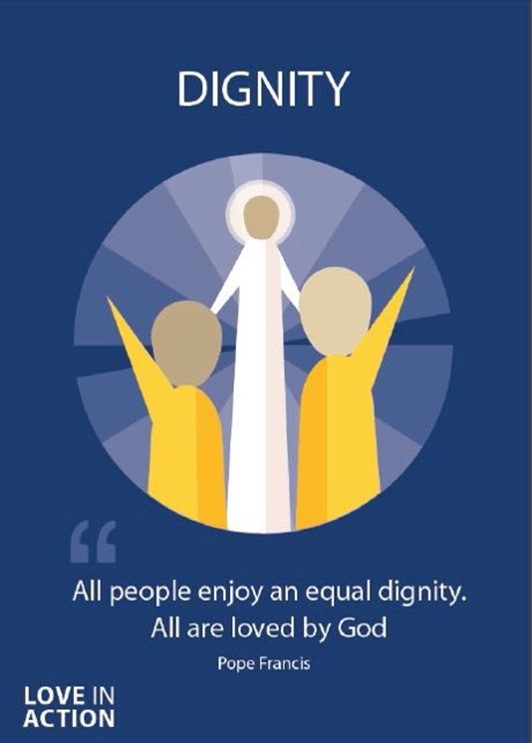
Dignity means ‘the state or quality of being worthy of honour or respect’. Therefore, ‘Dignity’ in Catholic Social Teaching means that every human being should be treated equally.
This is because everybody is made in God’s image and His likeness and, therefore, equal in the eyes of God. This is so important that the other principles are based on this.

‘Every person is immensely holy and deserves our love.’ Pope Francis
‘So God created humankind in his own image, in the image of God he created them; male and female he created them. … God saw all that he had made, and it was very good.’ Genesis
‘” You shall love your neighbour as yourself.” There is no commandment greater than this.’ Mark 12:
We promote the dignity of every person through various means.
1. Curriculum: At St Mary’s, we incorporate Catholic social teaching into their curriculum; pupils learn about the principles of human dignity, social justice, and solidarity. This includes following Pope Francis’s “Laudato Si” message and exploring topics like poverty, immigration, and the common good.
2. Faith Formation: We provide a religious education curriculum that emphasises the inherent dignity of every person as created in the image of God. Pupils are taught to respect and value the worth of all individuals, regardless of their background, race, or socioeconomic status.
3. Service-Learning: We encourage pupils to engage in service-learning activities that promote social justice and human dignity. Pupils volunteer around the school, participate in outreach programs, or advocate for marginalised communities’ rights.
4. School Culture: We teach a culture of respect, inclusivity, and compassion. This promotes a sense of community where pupils are encouraged to treat others with kindness, empathy, and understanding. This includes fostering an environment that rejects discrimination, bullying, and prejudice.
5. Role Modelling: Teachers, staff and pupils play a crucial role in promoting Catholic social teaching and the dignity of every person.