” Think like a Historian! “
At St Mary’s, we want our children to have no limits to what their ambitions are and grow up wanting to be Archaeologist, Heritage worker, History Teacher or a Museum Curator.
We believe a high-quality History education will help pupils gain a coherent knowledge and understanding of Britain’s past and that of the wider world. It should inspire pupils’ curiosity to know more about the past. Our curriculum equips pupils to ask perceptive questions, think critically, weigh evidence, sift arguments, and develop perspective and judgement. History helps pupils to understand the complexity of people’s lives, the process of change, the diversity of societies and relationships between different groups, as well as their own identity and the challenges of our time.

History at St Mary’s is taught across each year group in modules that enable pupils to study in depth key historical understanding, skills and vocabulary. Each module aims to activate and build upon prior learning, from EYFS to Year 6, to ensure better cognition and retention. Each module is carefully sequenced to enable pupils to purposefully layer learning from previous sessions to facilitate the acquisition and retention of key historical knowledge. As the children move through year groups, they are introduced to new Key Concept that are revisited throughout their time at school. Alongside the six key concepts, our children are encouraged to ‘Think like a Historian’ by focussing their enquiry into one or more of the following within a lesson: The Science of Time; the reason and result of things that happened in the past; how key people, places and events changed or stayed the same over time; similarities; how we know about the past; why people, events or ideas are important to our studies.
Each module is revisited as part of a spaced retrieval practice method to ensure pupils retain key knowledge and information. Children’s knowledge and understanding is continually assessed throughout through questioning, cumulative quizzes, feedback in marking that supports and strengthens understanding.
There are several key aspects to learning:
Substantive knowledge – this is the subject knowledge and vocabulary used about the past.
Disciplinary knowledge – this is the use of that knowledge and how children construct understanding through historical claims, arguments and accounts. The features of thinking historically may involve significance, evidence, continuity and change, cause and consequence, historical perspective and contextual interpretation.
Substantive concepts – such as community, knowledge, power and democracy are taught through explicit vocabulary instruction as well as through the direct study.
The impact of our History curriculum is that children are equipped with history skills and chronological knowledge that will enable them to be ready for the next key stage and for their future life.
- In EYFS, children can compare differences between the past and present and they can begin to recognise key historical events and figures from reading.
- The children understand our past and their ancestors. They can recall different time periods and reflect on how it has changed society today.
- They are passionate about History and its significance today.
- Children can access and follow an ambitious curriculum that has our vision for exceptionally high expectations as a driver.
- Standards of work are strong and consistent throughout school.
Enrichment
To further enhance our History curriculum we offer:
- Each class will be given the opportunity for out of school visits and experiences that complement their current learning.
- Artifacts are brought into school from local museums to enrich our curriculum
- Celebrate Remembrance Day across school including whole school displays
- Visits from historical characters to bring history into school
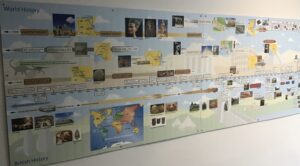
- Timeline displayed for all pupils to see showing current and past learning
Early Years
The Early Years Foundation Stage Curriculum supports children’s understanding of History through the planning and teaching of ‘Understanding the World past and present’ alongside primae areas Communication and Language being able to talk about past events in their own lives. These aspects teach children to find out about past and present events in their own lives, their families and other people they know. Children are encouraged to develop a sense of change over time and are given opportunities to differentiate between past and present by observing routines throughout the day, growing plants, observing the passing of seasons and time and looking at photographs of their life and of others. Practitioners encourage investigative behaviour and raise questions such as, ‘What do you think?’, ‘Tell me more about?’, ‘What will happen if..?’, ‘What else could we try?’, ‘What could it be used for?’ and ‘How might it work?’
Use of language relating to time is used in daily routines and conversations with children for example, ‘yesterday’, ‘old’, ‘past’, ‘now’ and ‘then’.


