
“It seems to me that the natural world is the great source of excitement: the greatest source of visual beauty; the greatest source of intellectual interest. It is the greatest source of so much in life that makes life worth living.” David Attenborough
At St Mary’s we aim to develop children’s curiosity and broaden their scientific thinking to encourage a love and passion of Science. We want them to have no limits to what their ambitions are and grow up wanting to be astronauts, forensic scientists, toxicologists or microbiologists. Our children are encouraged to be ambitious learners, ask questions, take risks and be creative in order to explore scientific ideas and concepts. It is through this approach that children at our school understand the importance of science in our world today and also for the future.
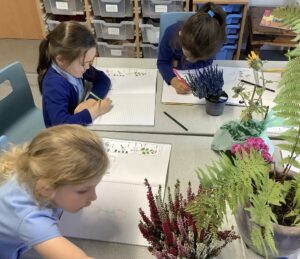
At St Mary’s our children develop their scientific knowledge, working scientifically skills and conceptual understanding through a broad and balanced, sequential curriculum, which inspires their ambition, encourages them to take risks and stimulates their curiosity about the world around them. Our enriched Science curriculum is a knowledge- engaged progress model which clearly outlines the key knowledge and vocabulary for each stage of the learning sequence. We also inspire a passion for learning in our children and build confidence to enable them to ask and answer questions and explore scientific lines of enquiry through practical activity, discussion and exploration.
‘The important thing is to never stop questioning’. Albert Einstein.
At St Mary’s we are passionate about implementing our Science curriculum through a rigorous, sequential, inquiry- based approach. Lessons are structured to improve metacognition in the children. Every lesson is defined by a clear outcome, with key knowledge and vocabulary shared with our pupils. Our teaching lesson principles are retrieve, explain, modelling of new concepts, checking understanding and application of learning through creative, practical activities and discussion. Alongside delivering substantive knowledge, we also teach children the disciplinary knowledge for them to think like a scientist. We develop children’s understanding of the nature, processes and methods of science through exposing them to a variety of science enquiries and outdoor experiences that help them to answer scientific questions about the world around them. We want to ensure that children are equipped with the scientific knowledge to understand the uses and importance of Science both today and for the future
As a result of Science teaching at St Mary’s you will see:
Children at St Mary’s are able to explain and demonstrate scientific concepts using key vocabulary to deepen their thinking. They can ask and answer scientific questions about the world around them and can suggest ways in which to answer these questions using one of the five types of scientific enquiry:
- comparative / fair testing.
- research.
- observation over time.
- pattern seeking.
- identifying, grouping, and classifying.
- problem solving.
Children are proud of the work that they produce which is demonstrated in the presentation and understanding of the work. Children are excited about their Science lessons and speak about how they enjoy learning through practical, creative and inquiry based activities.
Enrichment
At St. Mary’s we enrich our Science curriculum by:
- Planning bespoke whole school science activities each term, provided by specialist practitioners.
- Educational visits for children in Key Stage one and Key Stage two to stem museums linked to current Science topics which enhances the classroom learning.
- Enrichment activities for Key Stage one and Key Stage two pupils including Forest School.
- Whole school Science Selfie Competition to raise the ‘enjoyment of science with the school community.
- Termly workshop visits for Key Stage 2 from the Malton School Science Van linked to current Science topic.
Early Years
The Early Years Foundation Stage Curriculum supports children’s understanding of Science primarily through the planning and teaching of ‘Understanding the World. However, prime areas and other specifics play a large part in the development of science e.g communication & language supports questioning, physical development supports understanding of forces. Children find out about objects, materials and living things using all of their senses looking at similarities, differences, patterns and change. Both the environment and skilled practitioners foster curiosity and encourage explorative play, children are motivated to ask questions about why things happen and how things work. Our children are encouraged to use their natural environment around them to explore. Children enjoy spending time outdoors exploring mini-beasts and their habitats, observing the changing seasons, plants and animals. During the spring term children have the unique first hand experience of hatching and caring for live chicks. Children regularly participate in cookery and baking sessions which allows them to experience changes in state as ingredients are mixed, heated and cooled.


