
At St Mary’s Roman Catholic Primary School, our English Curriculum enables children to develop skills in reading, writing and speaking and listening in a robust, engaging and responsive way. We endeavour to instil a love of reading, writing and language which will last our children a lifetime, allow them to progress in their learning journey and empower them to become confident learners, encourage independence, build self-esteem and acquire a love of learning.
Writing
At St. Mary’s, we believe in the connectedness of vocabulary instruction, reading, transcriptional fluency and subject specific knowledge to writing. If pupils are able to draw upon a bank of words, knowledge and writing conventions, cognitive space is left for pupils to focus on the content of their writing. The Writing Curriculum we offer our children will allow them to obtain skills and confidence that will enable them to continue to reach their potential once they leave us.
Implementation
The programmes of study for writing at St Mary’s are constructed similarly to those for reading: oracy, transcription (spelling and handwriting) composition (articulating ideas and structuring them in speech and writing).
Our writing often uses our wider curriculum sequences of learning as a stimulus for writing, meaning new vocabulary and knowledge is recycled and reused in writing sessions, meaning sessions can have an explicit grammar or text convention focus.
Each writing cycle takes place over a series of weeks, which follows this process:
- Identify the context, purpose and audience for writing.
- Immerse pupils in quality models.
- Use worked examples to instruct and model key conventions and grammatical objectives, with opportunities for deliberate practice.
- Create a clear outline of the structure.
- Insert your own content.
- Internalise your text and its components.
- Record your writing, reading it aloud regularly.
- Edit your writing as you go for meaning secretarially for impact.
- Evaluate your writing against its intended purpose.
- Write independently applying the skills attained.
Our writing modules are progressive and sequential with clear end points, thus giving children a deeper experience of vocabulary, modelled published writing and grammatical features and components. At St Mary’s we plan to support children in their grammar application and sentence composition. This is taught at the start of the academic year to those children who require it, this is taught to build strong foundations for great writing opportunities.
Spoken Language
In school, oracy is a powerful tool for learning; by teaching students to become more effective speakers and listeners we empower them to better understand themselves, each other and the world around them. It is also a route to social mobility, empowering all students, not just some, to find their voice to succeed in school and life.’ Voice 21
Oracy underpins everything we do in school. Lessons are designed to maximise opportunities for children to talk in meaningful contexts using ambitious vocabulary and sentence stems. Children are taught to perform and speak for different purposes to a variety of audiences through our curriculum and Personal Development offer.
Our oracy strategy is progressive for pupils at all levels. The oracy framework uses four vital strands; physical, linguistic, cognitive and social and emotional. These strands guide our oracy planning in all areas of the curriculum.
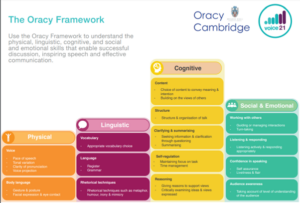
Through a high quality oracy curriculum, students learn through talk and learn how to talk effectively. The use of carefully planned, modelled and scaffolded talk in the classroom broadens and deepens children’s verbal responses and explanations. Teachers deliberately plan to enrich lessons with oracy and ensure that opportunities for student talk are a regular feature across the curriculum.
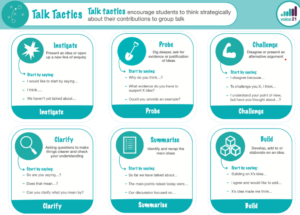
Our learners are encouraged to speak in full, coherent sentences when sharing their ideas and using spoken language. We have created a bank of differentiated sentence stems which our learners have access to in their classrooms and are carefully used in teacher’s planning.
Spellings
At St Mary’s we teach our children a systematic and progressive approach to spelling. The principles of the teaching of spellings is based on the spelling concept, pattern seeking, explicit teaching, systematic revisiting and application to writing. The lesson structure is as follows: Depth word study, sentence level dictation and reasoning and self-correction within writing. We want our children to be confident, accurate and ambitious spellers
Handwriting
At St. Mary’s Primary School, handwriting is closely linked to the Read Write Inc. phonics scheme. Handwriting is taught progressively and in-line with the requirements of the National Curriculum.
In the early stages children are taught:
● How to hold a pen/pencil correctly and form letters and numbers of regular size and shape.
● Write from left to write and top to bottom of a page.
● Start and finish upper and lower case letters correctly.
● Put regular spaces between letters and words.
● Phrases (inline with Read Write Inc.) are taught to help them remember the correct formation.
● The importance of clear and neat presentation in order to communicate meaning effectively.
In Year 1, the pre-cursive letter formation is taught. The children focus on starting and finishing letters in the correct place, so they are sitting on the line. In Year 2, the focus is on forming letters that are the correct size in relation to each other with the diagonal and horizontal strokes needed to join them so by Key Stage 2, handwriting is fluent.
In the later stages children are taught to write legibly in a joined style with increased fluency and speed. Pupils are encouraged to use different forms of handwriting for different purposes
It is a systematic and progressive approach which supports children of all ability levels. Teachers are expected to role model the school’s handwriting style when marking children’s work, writing on the board and on displays around the school.
Please see below for guidance on letter formation
Impact
At St. Mary’s, our children will be skilled, confident and enthusiastic writers. The impact on our children is that they have the knowledge and skills to be able to write successfully for a purpose and audience. With the implementation of the writing sequence being established and taught in both key stages, children are becoming more confident writers and have the ability to plan, draft and edit their own work. By the end of key stage 2, children have developed a writer’s craft, they enjoy sustained writing and can manipulate language, grammar and punctuation to create effect. As all aspects of English are an integral part of the curriculum, cross curricular writing standards have also improved and skills taught in the English lesson are transferred into other subjects; this shows consolidation of skills and a deeper understanding of how and when to use specific language, grammar and punctuation. At St Mary’s, the children are skilled at transcription and composition. They are confident and ambitious spellers and can use dictionaries to spell ambitious words. Children can use thesaurus to enhance vocabulary choice for effect. Our learners go into the world able to communicate effectively, are confident and take their writing onto the next stage of their education and into their adult lives.
Enrichment
- Within our school, we celebrate each child by allowing them the opportunity to write independently and freely within each unit, thus allowing expression of writing style and genre whilst still teaching the curriculum.
- Celebrate writing for all to see on our published writing work boards
- Celebrations of authors and themed writing events.
- Independent writing sessions to allow children to showcase their skills in each writing unit.
- Children adding to the school newsletter
Draft Copies of our progression documents can be found below.


