As a Nurturing School, we aim to focus on social and emotional development in a whole-school environment. We use the Nurture Principles to enable children to develop socially and emotionally throughout all learning.
What does nurture do?
- Helps us to develop our social and emotional skills
- Supports us as we grow
- Builds our resilience and makes us feel better about ourselves.
Research shows nurture has a positive impact on attainment as well as social and emotional aspects of learning. At the heart of nurture is a focus on wellbeing and relationships and a drive to support the growth and development of children and young people.
The concept of nurture highlights the importance of social environments and its significant influence on social emotional skills, wellbeing and behaviour. Children who have good nurturing experiences tend to do well in school, attend regularly, form meaningful relationships and are significantly less likely to offend or experience physical or mental health problems.
The nurturing approach offers a range of opportunities for children to develop their social and emotional skills and do well at school and with their peers, develop their resilience and their capacity to deal more confidently with the challenge’s life may bring.
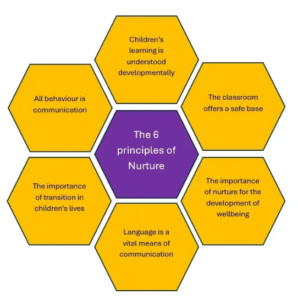
We are all individuals, and not everyone learns at the same rate or time. In school, we promote this by the teacher adapting the lesson so it is accessed by the children in the class. It is important that we are kind to ourselves and are patient. We try our best and be proud of what you can do.
The importance of nurture for the development of wellbeing.
The positive relationship between all teachers and children ensures that the wellbeing of the child is paramount. We ensure that our children feel safe to discuss their feelings and their mental health. We make sure that children know and feel that it is OK to be who they are.
This involves looking after ourselves and other people so it makes us feel good in mind and body. One way of doing this is showing kindness.
At St Mary’s we like to celebrate individual achievements as well as events that have happened in school. Every Friday we have a celebration assembly as well as having an Sporting Assembly celebrating children’s achievements from outside of school life. Throughout the week things are put on our social media pages for parents or other family members can celebrate our achievements.
All behaviour is communication.
It’s not always easy to express how we feel in words. The way we behave towards other people says a lot about how we are feeling. When we try and put ourselves in other people’s shoes and imagine how they are feeling, this is called empathy. We try and ask ourselves: How might they be feeling? Why might they behave that way? Are they feeling frustrated?
In classes, children have different signals that they can use if they need some time away from the classroom environment or that they would like a chat with someone.
The classroom offers a safe base.
At St Mary’s all of the classrooms have a safe base including a cosy reading area in each room. Pods and sofas are used in case a child needs a bit of time away from the classroom. Lamps and twinkly lights are used so we feel calm.
If children are upset, we ensure that teaching staff give them the time and a safe place to communicate. All children are given a voice and school develops a culture that allows all children to speak in class without the fear of judgement.
Children know that mistakes are a part of learning and their development and that each day is a fresh start.
Language is a vital means of communication.
We have a vocabulary rich curriculum that begins in EYFS, that ensures our children have the ability to communicate their needs.
What we say to people tells them a lot about us and how we are feeling. Talking to someone you trust, like a teacher or classroom assistant can help them to understand you and make you feel better soon.
In some classes, we use the zones of regulation so that teachers can see how we are feeling and help us to regulate our emotions.
The importance of transition in children’s lives
Transitions happen all the time at school and for some children this can feel scary and something that might feel uncomfortable. At times it can help to have social stories, this includes what might be happening throughout the day such as going on a trip or if something different is happening in school. This helps with children to understand what will be happening throughout the day.
When moving into the next school year, we ensure we have a smooth transition between classes. This includes meeting the class teacher beforehand, having a few days in the new room and also decorating things like bookmarks and pegs to make sure the classroom is unique to the children. We provide children with transition books over the summer if we have identified them as being likely to struggle.
Wellbeing in Mind Team
The Wellbeing in Mind Team consists of an NHS staff team, based in school, to offer support to our pupils experiencing common emotional wellbeing difficulties. They provide additional care and interventions for young people and families experiencing difficulties including:
- low mood
- anxiety
- low self esteem
The team works closely with external services so that those with more complex problems can get the right help, from the right people, more quickly.
Difficulties that young people experience can affect things like work, friendships and home life. Having the right support available when and where it’s needed can help to lessen the impact things like stress or anxiety have, both now and in the future.
The wellbeing in mind team is made up of NHS professionals including senior clinicians, higher-level therapists and education mental health practitioner trainees (EMHPs). For more information on the work of the Wellbeing in Mind Team, you may like to watch the following video.
Referrals to the Wellbeing in Mind Team are made by Gemma Lee.

